Frequency Domain Analysis
Frequency Domain Analysis includes the following calculation types:
In each of these calculation types, you can perform single calculations and parametric sweeps, including sweeps as a function of frequency.
General Parameters
The General Parameters calculation is available for all transmission line types. It allows you to calculate the characteristic impedance and a number of secondary transmission line parameters, determine the loss level in the transmission line, and calculate the transmission line length for a given loss level.
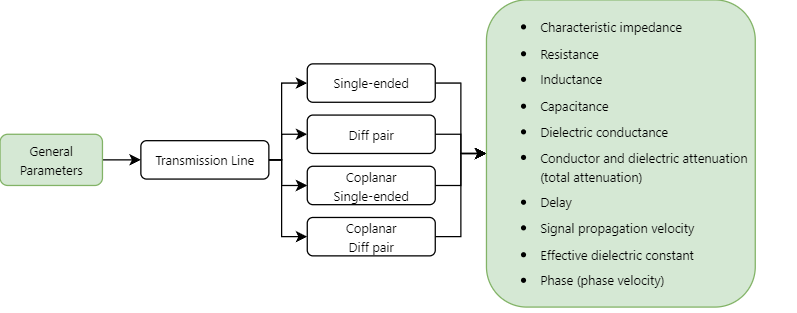
In the Projects panel, calculations are identified by names, which are formed as follows:
-
Single calculation – The name includes the calculated characteristic impedance (Zo) or differential characteristic impedance (Zdiff), as well as the frequency used in the calculation (FREQ). Example:
Zo=49.5613 Ohm, FREQ=300 MHz. -
Parametric sweep – The name includes the range of calculated characteristic impedance or differential characteristic impedance values, the range and step of the sweep parameter, and the frequency used in the calculation. Example:
Zo=49.5613...127.2094 Ohm, H1=0.1;1;0.1 mm, FREQ=300 MHz.If the sweep parameter is the line length (LTL), the calculated characteristic impedance or differential characteristic impedance is a single value for the entire LTL range. Example:
Zdiff=95.8612 Ohm, LTL=10;100;10 mm, FREQ=300 MHz. -
Parametric sweep with frequency as the sweep parameter – The name includes the range of calculated characteristic impedance or differential characteristic impedance values, as well as the frequency range. Example:
Zo=50.2759...49.1237 Ohm, FREQ=100;1000;100 MHz.
S-Parameters
The S-parameters calculation is available for all transmission line types. It allows you to evaluate the power efficiency of the transmission line and determine the level of reflected waves.
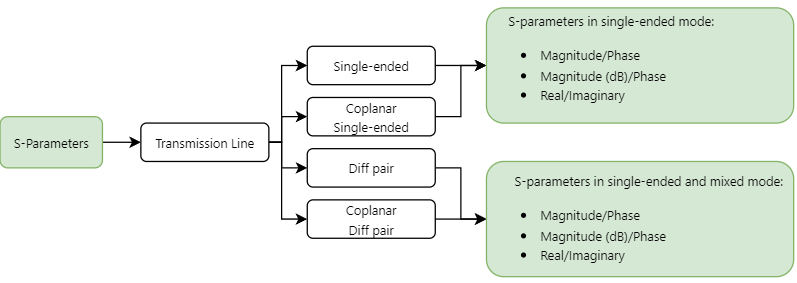
Calculation names are formed as follows:
-
Single calculation – The name includes the calculated characteristic impedance (Zo) or differential characteristic impedance (Zdiff), source impedance (ZS), load impedance (ZL), and the frequency used in the calculation (FREQ). Example:
Zo=46.5567 Ohm, ZS=50 Ohm, ZL=50 Ohm, FREQ=300 MHz. -
Parametric sweep – The name includes the range of calculated characteristic impedance or differential characteristic impedance values, the range and step of the sweep parameter, source impedance, load impedance, and the frequency used in the calculation. Example:
Zo=48.6805...45.087 Ohm, T1=0.015;0.055;0.005 mm, ZS=50 Ohm, ZL=50 Ohm, FREQ=300 MHz.If the sweep parameter is the line length (LTL), source impedance (ZS), or load impedance (ZL), the calculated characteristic impedance or differential characteristic impedance is a single value for the entire range of LTL, ZS, or ZL parameters. Example:
Zo=46.5567 Ohm, ZS=40;60;2 Ohm, ZL=50 Ohm, FREQ=300 MHz. -
Parametric sweep with frequency as the sweep parameter – The name includes the range of calculated characteristic impedance or differential characteristic impedance values, the frequency range, source impedance, and load impedance. Example:
Zo=47.2281...46.1457 Ohm, FREQ=100;1000;100 MHz, ZS=50 Ohm, ZL=50 Ohm.
Crosstalk
The Crosstalk calculation is available for single-ended transmission lines and differential pairs. It allows you to calculate crosstalk (voltage and phase) at specific frequencies at the near and far ends of matched transmission lines, and determine the minimum trace spacing required to ensure an acceptable crosstalk level.

Calculation names are formed as follows:
-
Single calculation – The name includes the calculated characteristic impedance (RS=RL=Zo) or the characteristic impedance of the line driven in odd mode (RS=RL=Zodd), the frequency used in the calculation (FREQ), and the number of transmission lines. Example:
Rs=Rl=51.344 Ohm, FREQ=300 MHz, 2 TL. -
Parametric sweep – The name includes the calculated characteristic impedance or the characteristic impedance of the line driven in odd mode, the range and step of the sweep parameter, the frequency used in the calculation, and the number of transmission lines. Example:
Rs=Rl=51.344 Ohm, H1=0.1;1;0.1 mm, FREQ=300 MHz, 2 TL. -
Parametric sweep with frequency as the sweep parameter – The name includes the calculated characteristic impedance or the characteristic impedance of the line driven in odd mode, the frequency range, and the number of transmission lines. Example:
Rs=Rl=51.344 Ohm, FREQ=100;1000;100 MHz, 2 TL.