Time Domain Analysis
Time Domain Analysis includes the following calculation types:
Waveform
The Waveform calculation allows you to compute and display the waveform of analog and digital signals after passing through a transmission line. This calculation type is available for all transmission line types.
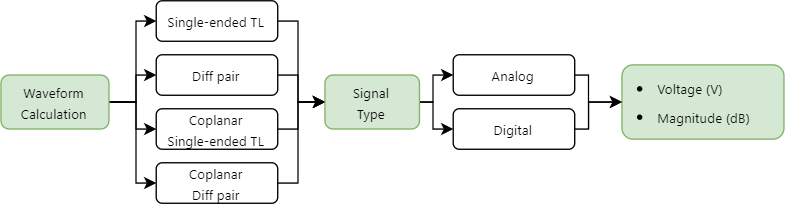
Within the Waveform calculation type, only single calculations are available. Parametric sweeps are not supported.
In the Projects panel, calculations are identified by names, which are formed as follows:
- Digital signal – The name starts with "D" and includes the calculated characteristic impedance (Zo) or differential characteristic impedance (Zdiff), source impedance (ZS), and load impedance (ZL). Example:
D, Zo=49.5613 Ohm, ZS=50 Ohm, ZL=50 Ohm. - Analog signal – The name starts with "A" and includes the calculated characteristic impedance (Zo) or differential characteristic impedance (Zdiff), source impedance (ZS), load impedance (ZL), and the frequency value (FREQ). Example:
A, Zo=49.5613 Ohm, ZS=50 Ohm, ZL=50 Ohm, FREQ=300 MHz.
S-Parameters
The time-domain S-parameters calculation allows you to evaluate how S-parameters change over time. This calculation type is available for all transmission line types.
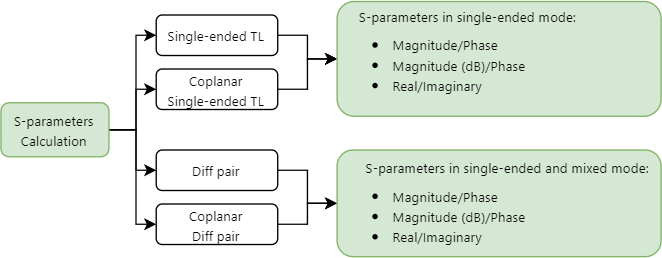
Within the S-parameters calculation type, only parametric sweeps with frequency as the varied parameter make sense. Single calculations typically have no practical meaning. Their results are not displayed in a graph.
Calculation names are formed as follows:
- Parametric sweep – The name includes the range of calculated characteristic impedance (Zo) or differential characteristic impedance (Zdiff) values, the frequency range (FREQ), source impedance (ZS), and load impedance (ZL). Example:
Zo=47.2281...46.1457 Ohm, FREQ=100 MHz;1 GHz;100 MHz, ZS=50 Ohm, ZL=50 Ohm.
Crosstalk
The time-domain Crosstalk calculation allows you to calculate the crosstalk level (voltage) at the near and far ends of the transmission line, and visualize the crosstalk waveform in a line graph. This calculation type is available for single-ended transmission lines and differential pairs.

Within the Crosstalk calculation type, you can perform single calculations for both digital and analog signals.
Calculation names are formed as follows:
- Digital signal – The name starts with "D" and includes the calculated characteristic impedance (RS=RL=Zo) or the characteristic impedance of the line driven in odd mode (RS=RL=Zodd), and the number of transmission lines. Example:
Rs=Rl=51.344 Ohm, 2 TL. - Analog signal – The name starts with "A" and includes the calculated characteristic impedance (RS=RL=Zo) or the characteristic impedance of the line driven in odd mode (RS=RL=Zodd), the frequency value (FREQ), and the number of transmission lines. Example:
A, Rs=Rl=94.1884 Ohm, FREQ=300 MHz, 2 TL.