Lossless Calculations
Lossless calculations are typically performed first when designing high-speed and high-frequency printed circuit boards.
Lossless calculations allow you to perform the following tasks:
- Calculate the characteristic impedance of a transmission line based on known geometric and electrophysical parameters.
- Determine the geometric parameters of a transmission line for a target characteristic impedance and PCB stackup parameters.
-
Calculate secondary transmission line parameters:
- Propagation delay
- Capacitance per unit length
- Inductance per unit length
- Signal propagation velocity
- Effective dielectric constant
- Transmission line geometric parameters
- PCB stackup parameters
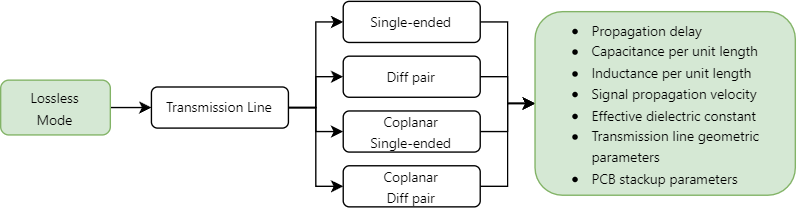
The following calculation types are available in Lossless mode:
- Single calculation – Calculates an impedance value and secondary parameters of a transmission line.
- Reverse calculation – Calculates transmission line parameters for a target impedance.
- Parametric sweep – Calculates impedance values (along with secondary parameters) at varying values of a selected sweep parameter. The sweep parameter is defined by a range of values and a step.
- Reverse parametric sweep – Calculates transmission line parameters for a target impedance at varying values of a selected sweep parameter. The sweep parameter is defined by a range of values and a step.
Calculation Names
Calculations are identified by names in the Projects panel. The names are generated according to the following templates:
- Single calculation – The name includes the calculated characteristic impedance (Zo) or differential characteristic impedance (Zdiff). Example:
Zo=51.344 Ohm. - Reverse calculation – The name includes the calculated value of the target parameter and the target impedance value. Example:
H1=0.0956 mm, Zo=50 Ohm. - Parametric sweep – The name specifies the range of calculated impedance values, the range of values for the sweep parameter, and the sweep step. Example:
Zo=64.7438...45.6891 Ohm, W1=0.1;0.2;0.01 mm. - Reverse parametric sweep – The name specifies the range of calculated values for the target parameter, the target impedance value, the range of values for the sweep parameter, and the sweep step. Example:
H1=0.0588...0.1112 mm, Zo=50 Ohm, W1=0.1;0.2;0.01 mm.